Elon Musk has never been short of crazy ideas, but the new Tesla Roadster takes things to another level.
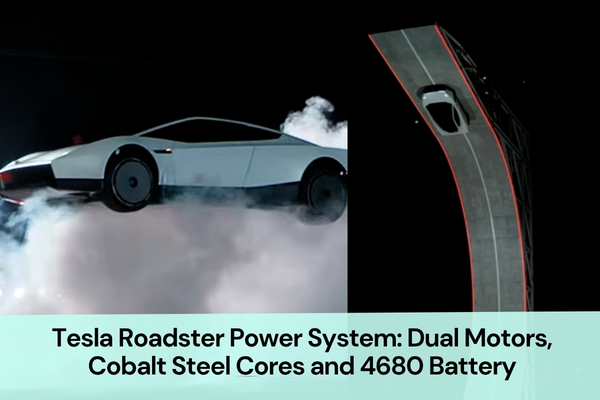
With dual rear motors, a megawatt-class power system, a 4680 battery, and SpaceX-inspired thrusters, Tesla aims to push the limits of electric supercars.
So, what makes the Tesla Roadster power system different? Let’s look at its electric motors, cobalt steel cores, 4680 battery, inverters, and rocket-inspired technology.
1. Tesla Roadster: Key Technical Specifications
| Specification | Details |
| Drive layout | Rear-wheel drive (RWD) |
| Number of motors | Two motors on the rear axle |
| Motor control | One independent inverter for each motor |
| Reduction gearing | Separate planetary reduction gear for each motor |
| Motor core material | Cobalt steel laminations |
| High-voltage system | About 800–1,000 V, depending on the version |
| Power output | Around 1,000 kW for the Performance version |
| Battery chemistry | High-power nickel-based lithium-ion |
| Battery cell format | Custom 4680 cylindrical cells |
| Battery cooling | Double-sided cell cooling |
| Battery capacity | Exact kWh figure not yet announced |
| Driving range | About 310–320 miles (499–515 km) |
| Fast charging | Target of around 500 kW |
| Vehicle weight | Base version target below 1,700 kg |
| Production timeline | Planned for 2028; not yet achieved |
The specifications are not identical across all versions. Power output, aerodynamic equipment, and cold-gas propulsion can vary. Features shown on a high-end prototype should not be treated as standard equipment on the base model.
2. Megawatt-Class Dual Rear Motors
The new Roadster is described as using two rear electric motors across the range. The Tesla Roadster power system uses a new 800–1,000 V high-voltage architecture. Each rear wheel has its own inverter control. This allows precise torque vectoring, helping the car stay stable and responsive through corners and during hard driving.
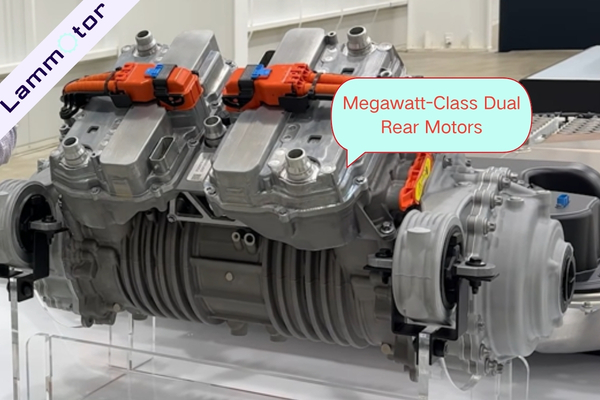
The Roadster drive unit is said to be 30% lighter than the one in the Model S Plaid, while providing 50% more power. The two motors are reported to deliver a combined 1 MW, or 500 kW each. The source draft describes this as about 1,500 horsepower and around 1,000 lb-ft of torque.
Tesla is targeting a weight of 1,700 kg (3,748 lb). If achieved, the source draft estimates a power-to-weight figure of about 2.5 lb per horsepower. Estimated range exceeds 300 miles. Lars also says charging from 10% to 80% could take around 10–12 minutes.
For a related look at Tesla motor design, read our article on the Tesla Cybertruck motor.
Cobalt Steel Motor Cores
Cobalt steel laminations are one of the most interesting material topics in the Tesla Roadster power system.
Tesla may use a high-saturation magnetic material to produce more torque from the same motor size. It could also help make the motor smaller while keeping the same power output.
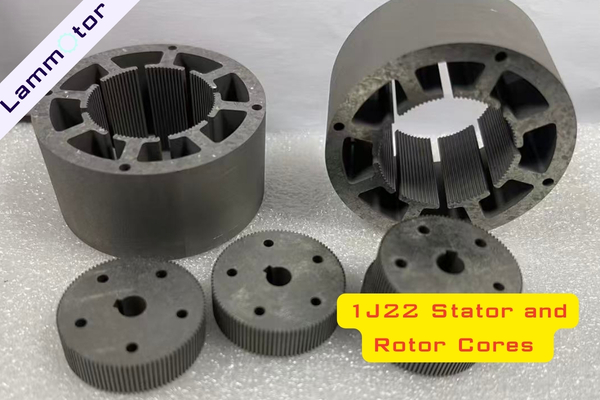
However, Tesla has not clearly disclosed the exact cobalt steel grade, lamination thickness, stator and rotor dimensions, pole and slot counts, or lamination joining method. We therefore cannot say that it uses a specific grade such as 1J22, Hiperco 50, or VACODUR 49.
Here is the Cobalt Fe stator and rotor cores we made, check the picture. If you are interested, please contact us for free.
3. Battery System: Custom 4680 Cells and Double-Sided Cooling
Like Tesla models since the Model S, the Roadster uses a skateboard-style platform. A large, flat battery pack sits between the wheels and supplies power to the two rear motors.
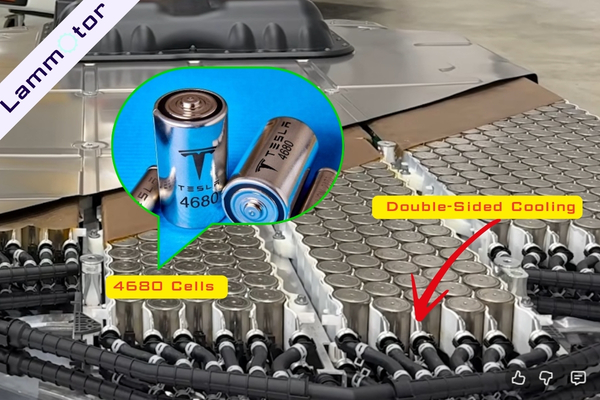
The Tesla Roadster power system is described as using Tesla 4680 cells with aluminum cell housings and a double-sided cooling design. The battery pack also has a titanium-alloy upper cover. Compared with conventional steel sheet, titanium can be made thinner and lighter.
Battery pack voltage is around 800 V. Tesla’s design goal is to cut charging time from 15% to 80% to about 10 minutes. Tesla says the car should travel more than 300 miles on a charge, but the exact battery capacity has not been announced.
Custom 4680 Cylindrical Cells
The Roadster uses specially developed 4680 battery cells. The name “4680” refers to a nominal diameter of about 46 mm and a height of about 80 mm.
The main design features include:
- A nickel-based lithium-ion chemistry designed for high-power discharge.
- An aluminum cell housing.
- A focus on sustained high power, not only energy density.
- Battery cells designed together with the thermal management system.
These details matter because the Tesla Roadster 4680 battery must support repeated bursts of high power while controlling heat.
Double-Sided Cooling
Some conventional cylindrical-cell cooling systems place the main heat-transfer channel on only one side of a cell. The Roadster instead uses a double-sided approach. Coolant can remove heat from areas closer to both sides of the cells.
Battery temperature control is a key part of the Tesla Roadster power system. During hard acceleration or fast charging, the battery must handle high electrical loads without excessive heat buildup.
4. Inverters and Independent Rear-Wheel Control
Both electric motors sit on the rear axle. Their combined power is reported to exceed 1 MW, with total torque above 1,400 N·m.
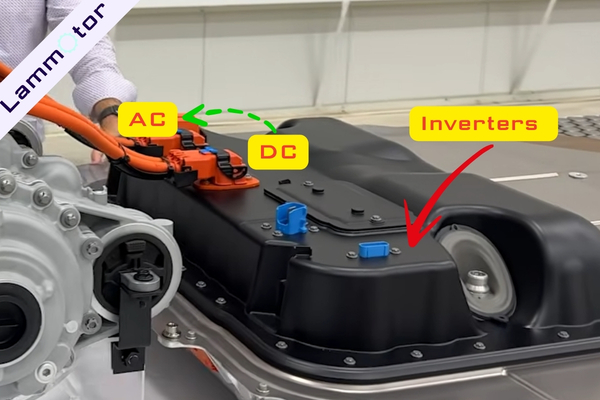
Each motor has its own inverter. Power reaches the left and right rear wheels through separate planetary gearsets, each with an approximate 8.4:1 reduction ratio. The Tesla Roadster power system therefore does not rely on a traditional mechanical differential.
This layout lets the vehicle adjust driving torque at each rear wheel independently. It provides the hardware needed for torque vectoring. The dual-motor rear-wheel-drive design also creates different options for vehicle weight and space layout.
To compare high-performance electric motor layouts, see our guide to the Tesla Model S Plaid vs. Lucid Air motor.
5. Four Roadster Versions: From Street Supercar to Single-Seat Rocket
The source draft describes four Tesla Roadster versions.
They range from a road-focused supercar to a track model and an invitation-only version designed for limited airborne movement. Not every feature is intended for every version.
| Feature | Standard | Performance | Thrust | Rocket |
| Positioning | Entry-level road supercar | High-performance road and track car | Track-focused limited edition | Invitation-only ultimate edition |
| Seating | Not specified | Two seats | Two seats | Single seat |
| Power Output | 1 MW | Upgraded torque | Not specified | Not specified |
| Torque | 960 lb-ft | Upgraded torque | Not specified | Not specified |
| 0–60 mph | Not announced | Under 1.6 seconds | Under 0.9 seconds (claimed 0.85 seconds in testing) | Under 0.59 seconds |
| Aerodynamics | Standard aerodynamic package | Advanced active aerodynamics | Not specified | Not specified |
| Suspension | Not specified | Adaptive suspension | Track-focused setup | Not specified |
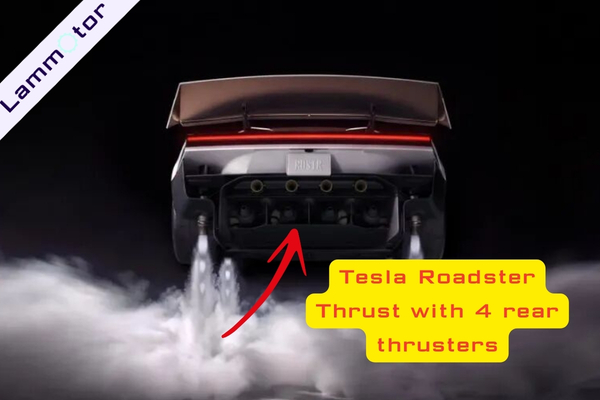
| Special Technology | Standard electric drivetrain | Multi-mode underbody suction fan system | 200 L high-pressure air tank and 4 rear thrusters | 600 L air storage and 10 distributed thrusters |
| Special Features | Conventional road performance | Road and track compatibility | Additional thrust-assisted acceleration | Short hovering, attitude control, and airborne maneuvers |
| Availability | Not specified | $50,000 refundable reservation deposit | Limited production | Invitation only |
Conclusion: What Makes the Tesla Roadster Power System Interesting?
The Tesla Roadster is not just about a fast 0–60 mph time. Its design brings together two independent rear motors, high-voltage power electronics, custom 4680 battery cells, advanced cooling, and, on certain versions, cold-gas thrusters.
The Tesla Roadster power system still has technical details that have not been fully disclosed. As more production information becomes available, its motor materials, inverter design, and battery cooling will be worth following closely.
At Lammotor, we manufacture motor stator and rotor laminations and core stacks for electric motor applications. If you are developing a high-performance motor and need support with electrical steel selection, lamination manufacturing, or core stacking, contact our team to discuss your drawings and project requirements.