
Motor Lamination Materials
Lammotor makes motor laminations from a wide range of electrical steels and special soft magnetic materials, with 10+ years of experience. We help you choose the right grade and thickness, then make laminations and stacks to your drawing, from a single prototype core to volume production. Samples are typically ready in 10 to 15 days.
Common Electrical Steel Grades We Source
We source non-oriented and grain-oriented electrical steel from major mills to match the performance and cost targets of different motors and transformers. Below are some of the common brands and grades we use:
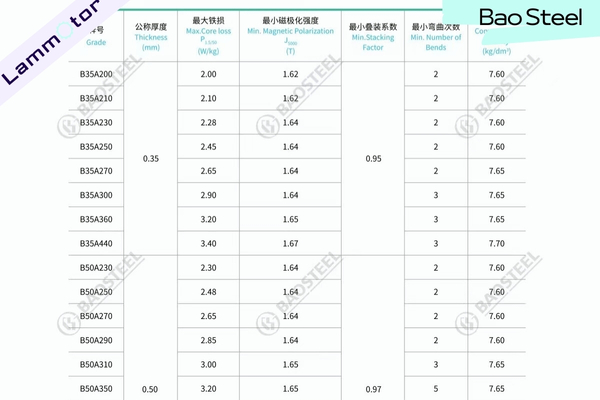
Baosteel
- B15AT1000, B20AT1200, B20AT1500, B20AV1200, B20AV1300, B25AV1300, B27AV1400, B30AV1500
- B35AV1700, B35AV1800, B35AV1900, B35AV2000, B35AV2100
- B35A250-Z, B35A270-Z
- B50A250, B50A270, B50A290, B50A310
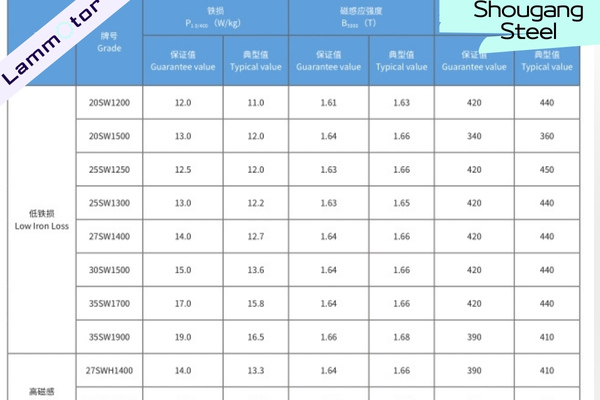
Shougang Steel
- 20SW1200, 20SW1500, 25SW1300, 27SW1400, 30SW1500, 35SW1700, 35SW1900
- 27SWH1400, 30SWH1500, 35SWH1900
- 27SWG1400, 30SWG1500, 35SWG1700
- 35SWYS500, 35SWYS900
- 25SW1250H, 27SW1400H, 30SW1500H, 35SW1700H
Kawasaki Japan: 15JNEH1000, 20JNEH1200, 20JNEH1500, 20JNHF1300
Ultra-Thin Silicon Steel: ST100
Other Motor Lamination Materials We Provide
In addition to traditional electrical steel, we also offer other special materials to meet the needs of high-end applications:
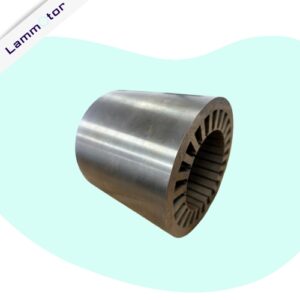
Amorphous Alloy
Amorphous alloys have very low core loss at high frequencies, but a lower saturation flux density than silicon steel and are hard to cut. They are used in high-frequency transformers and some high-efficiency motors.
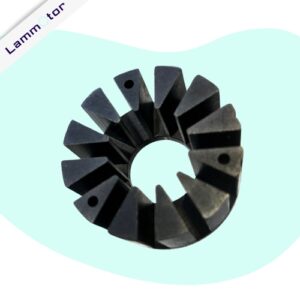
Soft Magnetic Composite
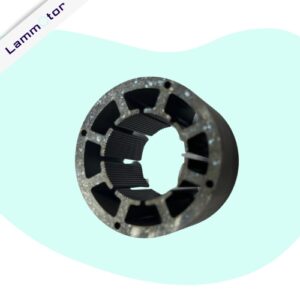
Soft magnetic composites (SMC) are insulated iron powder particles pressed into three-dimensional shapes. They have low eddy current losses at high frequencies and allow 3D flux paths, which suits axial flux motors. We press SMC cores in our own dies, using materials such as Somaloy 1P, Somaloy 3P and Somaloy 5P, and can also wind them.
Iron-Cobalt Alloy
Iron-cobalt alloys have the highest saturation flux density of the common soft magnetic materials, so they are used in aerospace and other high power density motors. We make laminations from 1J21, 1J22 and 1J27, which are equivalent to Hiperco 50 and Hiperco 27, by wire EDM and bond them into stacks.
Motor Lamination Materials by Application
Different types of motors require different lamination materials. Below are some common applications and the recommended materials:
- Transformers typically use grain-oriented silicon steel, which has very low core loss along the rolling direction, making it ideal for power and distribution transformers.
- EV traction motors usually use thin, high-grade non-oriented silicon steel, which keeps core loss low at high speeds and high frequencies.
- Ultra-thin silicon steel is used in high-speed and high-frequency motors, such as drone and spindle motors, and as an alternative to amorphous cores. We can process ultra-thin silicon steel down to 0.10 mm.
Our Motor Laminations Manufacturing Capabilities
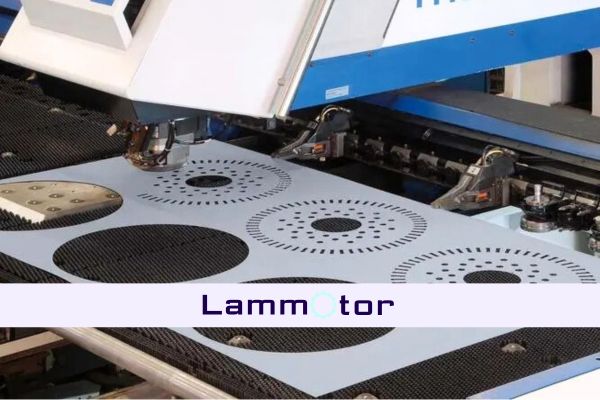
We offer prototyping and large-scale motor lamination manufacturing. Our custom manufacturing and assembly solutions can meet all your motor lamination needs – from reverse engineering to final production.
Our motor lamination services include:
Motor Lamination Materials FAQs
It depends on the operating frequency, efficiency target and cost. Industrial motors running at 50/60 Hz usually use 0.35–0.5 mm non-oriented grades, while high-speed and EV traction motors use thinner low-loss grades of 0.2–0.35 mm, and we can process steel down to 0.10 mm. Send us your speed, pole count and efficiency target and we will suggest suitable grades.
Non-oriented steel has similar magnetic properties in all directions, so it suits rotating motors where the flux direction keeps changing. Grain oriented steel has much lower loss along the rolling direction and is used mainly in transformers. Read our comparison of grain oriented and non-oriented steel.
No. We can make a single prototype in the material you choose, and we can also make samples in two or three grades so you can compare them on test.
Laser-cut or wire-cut samples are usually ready in 10 to 15 days. Lead time can be longer when the material is not in stock, such as cobalt-iron or special thin-gauge steel.
Cobalt-iron alloys such as 1J21, 1J22 and 1J27 have the highest saturation flux density, so they allow more torque in a smaller motor. They are expensive and need a special heat treatment, so they are used mainly in aerospace and high-performance motors. We make cobalt-iron cores by wire EDM and bonding.
SMC (soft magnetic composite) is pressed to shape and carries flux in three dimensions, which suits axial flux stator cores; we make Somaloy 1P, 3P and 5P parts with our own tooling. Amorphous alloy has very low loss at high frequency, but the ribbon is very thin and brittle, which makes cutting and stacking more difficult.
A DXF, STEP or PDF drawing, plus the material grade (or your loss and flux density targets if the grade is still open), thickness, stacking method and quantity.
Yes. Most of our customers sign an NDA with us before sending drawings, and we are happy to sign yours.
Contact Lammotor for Motor Laminations
If you have any questions about motor lamination materials or our manufacturing capabilities, feel free to contact us. Our professional team will provide customized solutions according to your needs.