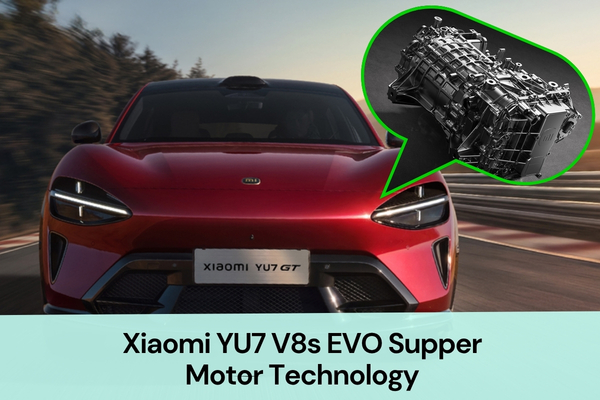
Xiaomi V8s EVO Supper Motor is one of the most talked-about electric vehicle motor technologies in 2025. But what makes it so special?
How does it achieve an ultra-high speed of 28,000 rpm, deliver 611 PS of peak power, and reach an impressive peak efficiency of 98.38%?
Let’s take a closer look at the key technologies behind the Xiaomi V8s EVO Supper Motor.
Rotor Maximum Speed 28,000 RPM
For electric vehicle motors, higher rotational speed generally means higher power output from a more compact package.
The Xiaomi V8s EVO Supper Motor reaches a maximum speed of 28,000 rpm, which equals more than 466 revolutions per second. At such extreme speeds, the rotor experiences enormous centrifugal forces. Even a small design weakness can lead to deformation or structural failure.
To overcome this challenge, Xiaomi used AI-assisted rotor topology optimization.
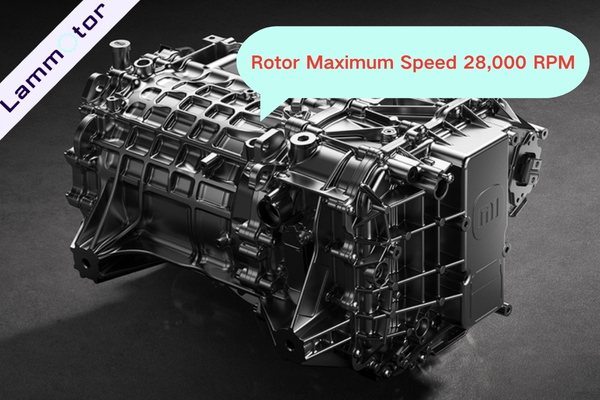
Engineers simulated more than one million different rotor silicon steel lamination designs. By continuously optimizing the stress distribution inside the rotor, they eventually found a design that balances both strength and performance.
What is especially impressive is that the V8s EVO achieves this 28,000 rpm speed without relying on additional reinforcement methods such as carbon fiber wrapping. Instead, Xiaomi achieved the result through rotor structure optimization alone.
The result is a high-speed electric motor capable of delivering up to 611 PS from a single motor.
Self-Developed Silicon Carbide Power Module
High rotational speed is only part of the equation. An electric motor also requires a powerful current supply.
In an electric vehicle, the motor control system acts like the body’s circulatory system, while the power module serves as the heart.
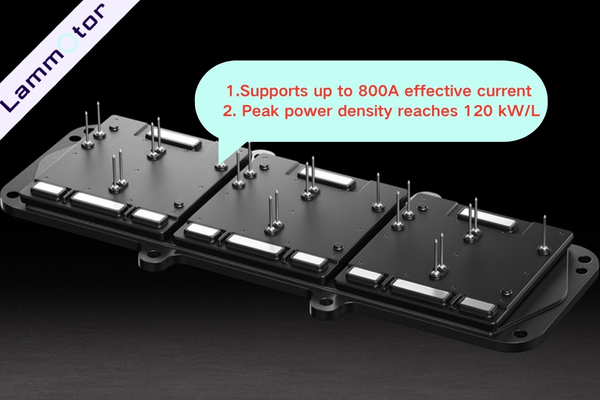
The Xiaomi V8s EVO Supper Motor uses Xiaomi’s self-developed Silicon Carbide (SiC) Power Module, which offers several important advantages:
- Supports up to 800A effective current across the entire voltage range
- Peak power density reaches 120 kW/L
- Higher voltage resistance capability
- Improved thermal management and cooling performance
Compared with conventional solutions, this new SiC power module increases overall motor output by approximately 5.9%.
For high-performance EVs, this translates into stronger acceleration and more stable power delivery during demanding driving conditions.
0.15 mm Ultra-Thin Silicon Steel Laminations
The motor core material plays a critical role in determining motor efficiency.
The stator core and rotor core are built from stacked silicon steel laminations. During motor operation, changing magnetic fields generate eddy currents inside these laminations. These currents create energy losses commonly known as iron losses or core losses.
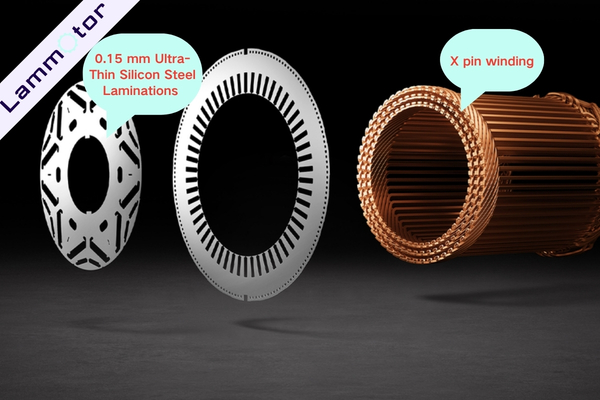
One of the most effective ways to reduce iron losses is to use thinner silicon steel laminations.
The Xiaomi V8s EVO Supper Motor uses 0.15 mm ultra-thin silicon steel laminations in both the stator and rotor. Compared with the previous generation, the laminations are significantly thinner.
This brings several benefits:
- Iron losses reduced by 18.7%
- Lower motor temperature rise
- Reduced energy consumption
- Higher efficiency at high-speed operation
For electric vehicles, lower iron losses directly contribute to longer driving range and better highway efficiency.
X-Pin Hairpin Winding Technology Improves Efficiency Further
Iron loss is not the only source of energy loss inside an electric motor.
Another major factor is copper loss, which comes from the heat generated when current flows through the motor windings.
To address this issue, Xiaomi developed its own X-Pin Hairpin Winding Technology.
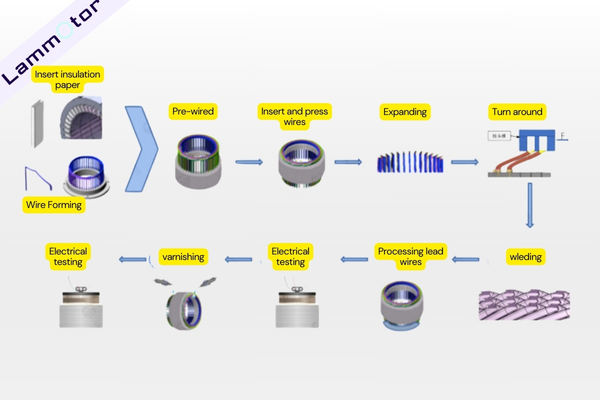
This technology significantly increases slot fill rate, allowing more copper conductor material to be packed into the stator slots. As a result, it helps:
- Reduce winding resistance
- Lower heat generation
- Decrease copper losses
- Increase power density
According to Xiaomi, the X-Pin winding design reduces copper losses by approximately 3.6%.
When combined with the 0.15 mm ultra-thin silicon steel laminations, the technology helps the Xiaomi V8s EVO Supper Motor achieve an outstanding 98.38% peak efficiency.
In practical terms, only about 1.6% of electrical energy is lost as heat, placing the motor among the industry’s most efficient electric drive systems.
Dual Permanent Magnet Synchronous Motors
The Xiaomi YU7 GT uses a dual-motor electric drive system.
The combination of the Xiaomi V8s EVO Supper Motor and the front-mounted V6s Plus motor produces a total output of 1,003 PS.
This enables the vehicle to achieve:
- Top speed of 300 km/h
- 0–100 km/h acceleration in just 2.92 seconds
At the same time, Xiaomi has introduced a front motor disconnect mechanism.
When the vehicle enters Eco Mode, the front motor is physically disconnected from the drivetrain. The rear motor handles propulsion by itself, reducing mechanical drag and improving efficiency.
According to official data, this technology can provide up to 20 km of additional CLTC driving range.
When maximum performance is needed, both motors work together. When efficiency becomes the priority, the vehicle can operate with a single motor. This flexible strategy creates an excellent balance between power and range.
Which technology do you think contributes the most to the performance of the Xiaomi V8s EVO Supper Motor?
Feel free to share your thoughts in the comments below.
Looking for a Reliable Motor Core Manufacturer?
If you are developing EV traction motors, hub motors, permanent magnet synchronous motors, or high-efficiency industrial motors, and need: Stator cores, Rotor cores, Silicon steel laminations, stator winding.
Talk to our engineering team today and discover how Lammotor can support your next motor project.