
Prototype Motor Laminations in China
Lammotor makes prototype motor laminations in China for engineers who need to test a new stator or rotor design before ordering production tooling. We laser cut or wire cut custom motor laminations to your drawing, stack them into finished cores and ship samples from a single piece, typically in 10 to 15 days.
Because no die is needed, you can change the design between test rounds at low cost. When the design is fixed, we build the stamping die and move your part to volume production in the same factory.
Rapid Prototyping of Motor Lamination Stacks
Prototype laminations are cut from the same electrical steel grade and thickness you plan to use in production, so the results you measure on the prototype motor match what you will get in volume. We can also make prototypes in cobalt-iron alloys and in thin-gauge silicon steel down to 0.10 mm.
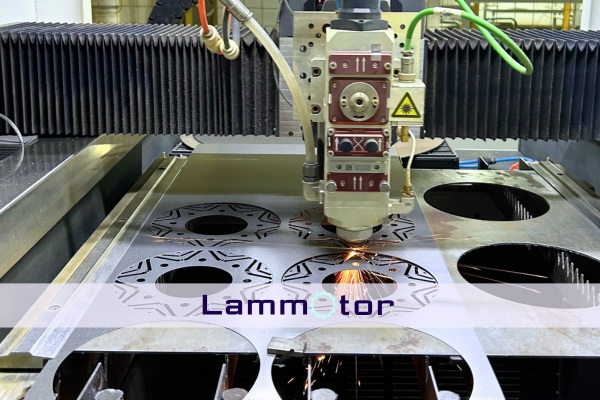
Laser Cut Prototype Laminations
Laser cutting is the fastest way to make prototype laminations: the shape comes straight from your DXF file, with no tooling, and complex slot and magnet pocket shapes are no problem. The cut edge has a small heat-affected zone and a slight burr, which raises core loss a little compared with stamped parts, so we keep the cutting parameters tuned for electrical steel.
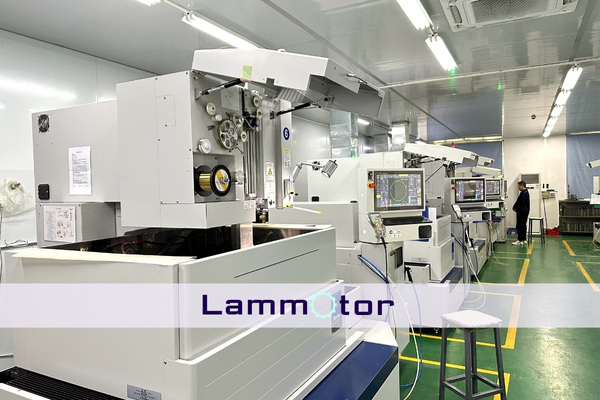
Wire EDM Prototype Laminations
Wire EDM cuts a clamped stack of laminations with a thin electrode wire. It gives the highest accuracy and almost no burr, which makes it the best choice for small parts, tight tolerances and hard materials such as cobalt-iron. It is slower and costs more per part than laser cutting, so it is used mainly for small quantities.
Comprehensive Testing Services
Quality Control for Prototype Lamination Stacks
A prototype is only useful if it matches your drawing and material specification, so every prototype order goes through the same checks as production.
Before cutting, we test the core loss of the incoming electrical steel to confirm the material grade. Our inspection equipment includes a projector, a CMM and a pull-out force tester.
Each prototype is checked for dimensions, burr height, stack height and perpendicularity, and we test the pull-out force of the stack to confirm the laminations are held firmly together.
You receive an inspection report with every prototype order. When you move to production, the first pieces from the new die are checked against the approved prototype before volume production starts.
Materials for Prototype Motor Laminations
Cold rolled motor lamination (CRML) steel: a low-cost option for small motors where efficiency is less critical.
Non-oriented silicon steel: the standard material for most motors, with low core loss. See our electrical steel laminations and motor lamination materials.
Thin-gauge silicon steel (0.10–0.20 mm): for high-speed and high-frequency motors, where eddy current loss matters most. Grades such as M15, M19 and M27 are ranked by core loss.
Cobalt-iron alloys (1J21, 1J22, 1J27): the highest saturation flux density, for aerospace and high-performance motors. These are cut by wire EDM and bonded into stacks.
OUR SERVICES
Why Choose Lammotor for Prototype Motor Laminations
Besides standard stator and rotor laminations, we make segmented, skewed and axial flux prototypes to your drawing.
Manufacturing Capabilities
Prototype stacks can be welded (MIG, TIG or laser), bonded or riveted. We also offer epoxy coating, stator winding and OD grinding, so you receive a complete core ready for testing.
Engineering Support
Our engineers review every drawing before cutting and point out features that will be hard to produce in volume, such as very narrow teeth or sharp slot corners, so the prototype design can move straight to stamping.
Fast Lead Time
Laser-cut and wire-cut prototypes are typically ready in 10 to 15 days, depending on the design, material and quantity.
Prototype Motor Laminations FAQs
Laser cutting is faster and costs less for most stator and rotor prototypes. Wire EDM is better for very small parts, tight tolerances, cobalt-iron alloys and designs that need almost no burr. We recommend a method after reviewing your drawing.
Yes, and we recommend it. Using the same grade and thickness means the core loss and performance you measure on the prototype motor will match volume production.
No. One prototype core is enough to start, and we can make a few variants of the same design so you can compare them on test.
Prototype laminations are typically ready in 10 to 15 days. Stacking, epoxy coating or winding may add a few days.
Interlocking needs a stamping die, so prototype stacks are welded, bonded or riveted instead. Skewed rotors are stacked in a fixture to match the skew angle on your drawing.
Once the design is approved, we build a progressive die for volume production. For some common sizes we already have dies, which can save the tooling cost.
A DXF, STEP or PDF drawing, plus the material grade, thickness, stack height, stacking method and quantity for each prototype round.
Yes. Prototype designs are often confidential, so most of our customers sign an NDA with us before sending drawings.
Get a Quote for Prototype Motor Laminations
Send us your drawing in DXF, STEP or PDF format with the material grade, thickness, stacking method and quantity, and we will reply with a quote and lead time. We make prototype laminations for DC motors, stepper motors, servo motors, BLDC, induction and synchronous motors.